Skip to content
In development now

An internal database platform you don’t have to build

Developers want a database in minutes; you want every one of them highly available, backed up, monitored and changed by the rules. ElastiCluster gives teams self-service on your company’s servers, inside projects, environments and policies you control, with single sign-on, approvals and an audit trail.
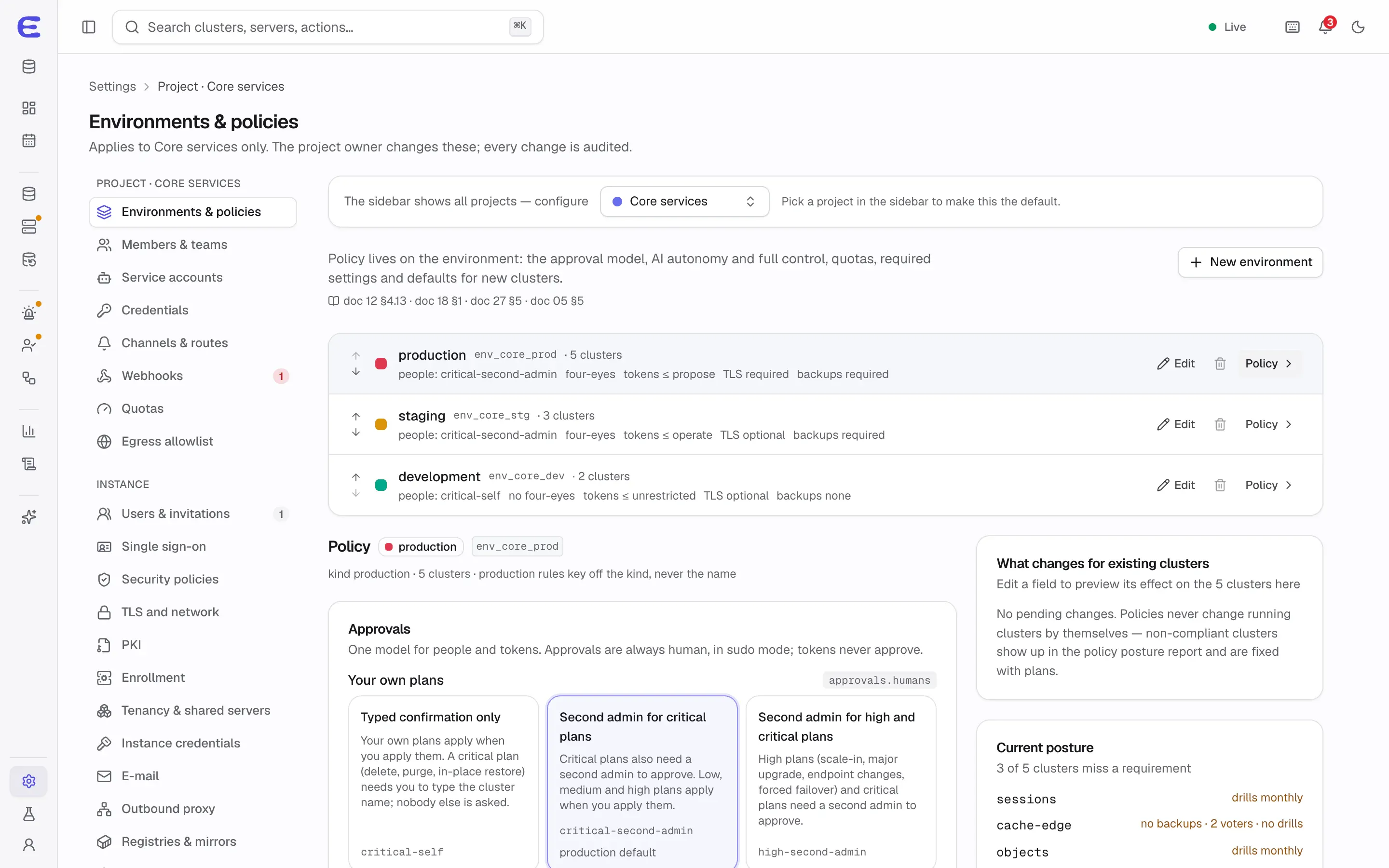
Environments and policies for a project: production, staging and development, each with approval rules, AI autonomy limits and backup requirements, and the production policy being edited.
Environments and their policies. Interactive demo, simulated data. Open this screen in the demo

Projects, environments and policies

Projects and environments are being built now. Each team gets a project. Inside it, environments such as production, staging and development carry the rules: who approves which risk, how far AI assistants may go, whether backups and drills are required, when the maintenance window is and which engine versions are allowed. Production rules follow the environment’s kind, never its name, so renaming an environment can’t weaken them. Policy always wins over a template’s values.

The defaults a new project starts with:
RuleProductionStagingDevelopment
ApprovalsA second admin for critical plans, four-eyes onA second admin for critical plansApprove your own critical plans after typing the name
AI assistantsPropose onlyApply up to medium riskUnrestricted
BackupsRequired, encrypted, weekly drills, immutable second copyRequiredOptional
Maintenance windowSunday 04:00 to 06:00Any timeAny time
Automatic minor upgradesOffOnOn

Self-service without a ticket queue

  • Templates package your standard setups, such as “PostgreSQL HA, standard”, as versioned starting points. Developers pick one, choose servers and see the plan. Being built now.
  • Quotas per project and environment cap clusters, memory, CPU and disk, reserved when a plan is validated and checked again when it runs. Being built now.
  • Roles from viewer to owner, granted per project today and per environment soon; teams and service accounts follow in v0.8. Developers can query where allowed; operators run day-2 changes; admins approve the risky ones.
  • Servers can be shared between projects through explicit grants, and a project’s outbound connections are limited to an allowlist.

Integrate with what you run

  • Single sign-on with OpenID Connect (Keycloak, Authentik, Zitadel, Entra ID, Okta or Google), with teams synced from groups and passkeys, planned for v0.8.
  • REST API and CLI: OpenAPI 3.1 with stable error codes and live updates, working today; the ecl CLI with contexts, browser sign-in and apply and diff, being built now. A Terraform and OpenTofu provider is planned after v1.0.
  • Webhooks as signed CloudEvents, with retries and replay, planned for v0.8.
  • Metrics through a Prometheus-compatible endpoint for your Grafana, or sent on to Prometheus, VictoriaMetrics or Mimir, planned for v0.3.
  • Audit exported to JSON lines, syslog, a webhook or S3, with a verifiable chain, working today.
  • AI assistants through the built-in MCP server, within each environment’s limits, planned for v0.3.

Evidence for audits and reviews

Reports show availability per cluster minute by minute, failovers, backup success and restore drills with measured restore times, plus governance views: who has access to what, which credentials exist and where policies differ from the defaults. They export to CSV and print-ready PDF. Reports are planned for v0.8.

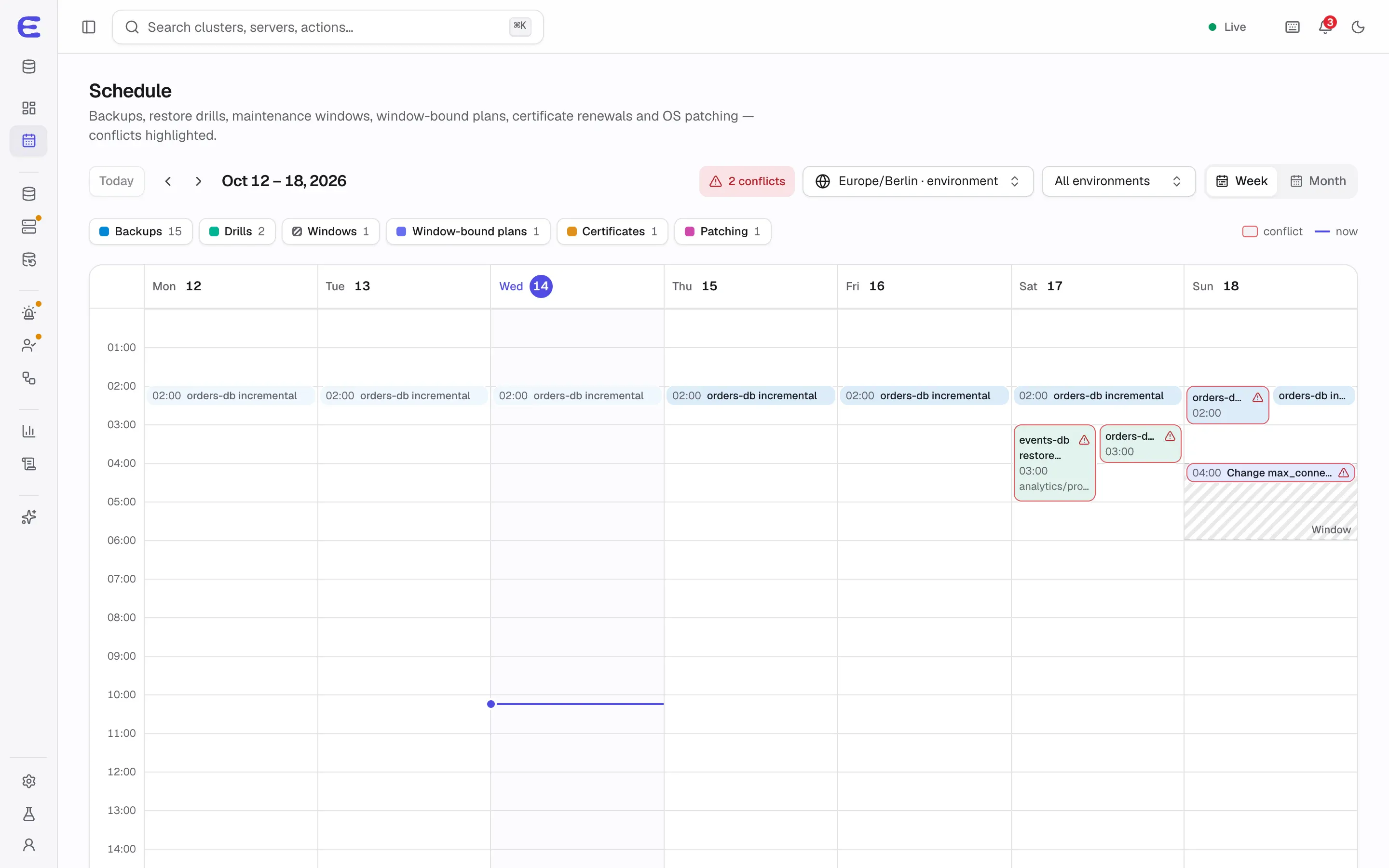
Schedule calendar for a week: backups, drills, maintenance windows, window-bound plans, certificate renewals and patching, with two conflicts highlighted and environment time zones.
The schedule shows backups, drills, windows and patching across the fleet, with conflicts. Interactive demo, simulated data. Open this screen in the demo

Scale and footprint

One control plane is designed for about 500 servers and 300 clusters, with 50 people in the console and 20 AI clients at the same time, in a single container with its own database. There is no Kubernetes cluster, no separate database and no message queue to run for it.

Status

Projects, environments, policies and quotas are being built now; roles, sudo mode, personal access tokens and the audit log already work in development builds. Single sign-on, teams, webhooks, the schedule calendar and reports are planned for v0.8. See the roadmap.

Try the console before it ships

The interactive demo runs the whole console on simulated data. Trigger a failover, approve an AI assistant’s plan, restore a backup to a point in time. Nothing to install.